As a volunteer

Are you an enthusiastic diver who enjoys helping others achieve their goals?

Several IAHD training centers have openings for volunteers.

Are you an enthusiastic diver who enjoys helping others achieve their goals?

Then we have good news!

Our Disabled Diving Foundation Fun Diving is looking for volunteers like you—divers and instructors from various diving organizations—who want to work with us to ensure that people with disabilities can enjoy diving safely and responsibly.

As a volunteer at our Foundation, you will have the opportunity to further develop yourself. You can participate in training courses offered by renowned organizations such as IAHD.

And there is more! From September through June, we offer weekly swimming, snorkeling, and diving activities that you can join for a small fee. This way, you stay fit! Don't hesitate any longer and drop by on one of our days without obligation.

Experience the great atmosphere of our Foundation and meet our enthusiastic participants.

Together, we make the underwater world accessible to everyone!

You are most welcome!

Contact:

This email address is being protected from spambots. You need JavaScript enabled to view it.


If you are interested, please let us know by sending an email to This email address is being protected from spambots. You need JavaScript enabled to view it..

It's great that you are interested in Stichting (on)Beperkt Duiken! Are you already a certified diver and would you enjoy helping people with disabilities learn to dive? Do you live somewhat near Alkmaar or Lisse, or are you willing to travel there?

Then Stichting (on)Beperkt Duiken could really use your help.

We are looking for volunteers who are willing to help at the swimming pool on a Saturday or Sunday afternoon about 10 times a year, and possibly one or a few times a year in open water (e.g., Vinkeveen).

The group in Lisse dives on Saturdays, and the one in Alkmaar on Sundays. All volunteers, dive instructors, and supervisors are welcome and will have the opportunity to take an IAHD refresher course within the foundation to guide this target group in a responsible manner. Previous experience with this target group is not a requirement.

Feel free to come and see for yourself, above or below the water, how much fun this is.

How can you help?

At IAHD, we dream of a society where no one stands alone.
[arrow-down]

Where everyone can participate, even when it is not a given. For us, that means making the underwater world accessible to people with disabilities. We call this a connected society, both above and below water.

Every day, we see how special this turns out. Volunteers helping someone take their first dive. Instructors going that extra mile so that someone feels safe and free underwater. Dive teams where new friendships are formed and boundaries are pushed. It is ordinary people making something possible for someone else.

Driven by the conviction that a disability need not be a barrier to enjoying diving. It is precisely these initiatives that set things in motion. They show what can happen when we trust and support each other and enter the water together.


  • Search and find an instructor

  • Become a volunteer

  • Help out as a foundation

Impressions vidéo

Nous recevons régulièrement de nouvelles vidéos de nos instructeurs. Nous publions ici les vidéos les plus récentes.
Pour voir toutes les vidéos, rendez-vous sur notre chaîne YouTube.

[arrow-down]
  • IAHD promotionfilm

    IAHD promotion

    This promofilm gives a good idea of the impact that Scuba diving, conducted by IAHD, has on disabled people.

  • Zwemsportdag 2026 Weert - Iedereen kan Sporten - Midden Limburg

  • IAHD cross-over opleiding.

    IAHD cross-over opleiding

    IAHD instructeur cross-over opleiding. Gegeven door IAHD Managing Director Gerard Oijnhausen.

  • Promofilm Dolfijnenreis 2020 Fun Diving

    Promotie video van de 'dolfijnen duiksafari' van Stichting Gehandicaptenduiksport Fun Diving die gehouden is Sataya Reef, Egypte.

  • Egypt december 2025

    Trip to Egypte

  • IAHD Alexander en Rik @Todi

    IAHD dive at Todi Belgium with 2 kids for an unforgattable experience.

  • IAHD instructeur cross-over opleiding

    Informatie over de IAHD Instructor cross-over opleiding.

  • Nicky's Ultimate Dive Initiation

    Join Nicky as she explores the riches of the TODI Aquarium on her first scuba diving initiation with the TODI IAHD Dive Instructors.

  • IAHD training Buenos Aires, Argentina

    IAHD Instructor Trainer Daniel Zuber shares underwater emotions IAHD Training.

  • Anneke vd Werff (EN subs)

    For IAHD I had a fun conversation with Anneke (alias: Duikmuisje)

  • IAHD ITC Buenos Aires,

    A summary of the IAHD Instructor Training course and Adaptive Scuba training with divers with disabilities past Weekend in Buenos Aires, Argentina.

  • Training Diary pt. 1

    'Rueda Nomada' (javier & maria) found me through Facebook and wanted to get their diving certificate.

  • Training Diary pt. 2

    These sessions were focused on theory and practical skills.

  • Training Diary pt. 3

    Last part of Javier & Maria journey. It was fun packed, challenging and rewarding for everybody. Now go dive the world!!

  • IAHD Intro to Scuba Diving

    IAHD Intro to Scuba Diving

    A first impression of a paralyzed person in scuba diving

  • Met IAHD in Njivice - Kroatie

    Met IAHD in Njivice - Kroatie

    IAHD cursus gegeven in September 2017 in Njivce - Kroatie.

  • Scuba Experience Italy

    Scuba Experience Italy

    IAHD Instructor Trainer Stefano Fei conducted an Scuba Experience for mentally limited people. They where all very exited about this experience

  • Interview Submerge IAHD

    Interview Submerge IAHD

    In dit interview van Submerge verteld IAHD Managing Director Gerard Oijnhausen meer over IAHD.

  • IAHD Istanboel 2014

    IAHD Istanboel 2014

    IAHD promotion and instructor cross-over course in 2014 in Istanboel, Turkey.

  • IAHD Bodrum 2014

    IAHD Bodrum 2014

    IAHD cursus gegeven in 2014 in Bodrum.

  • CDTC (NL-taal)

    Introduction of the Curaçao Dolphin Training & Research Centre (CDTC).

  • CDTC (DE-Sprache)

    CDTC (DE-Sprache)

    Introduction of the Curaçao Dolphin Training & Research Centre (CDTC).

  • Кросовер курс International Association for Handicapped Divers (IAHD)

    Het Oekraïens Instituut voor Onderwateronderzoek heeft ook een revalidatieprogramma ontwikkeld door middel van duiken.

  • Adaptive Scuba IAHD Turkey @okenosdiving

    To try out scuba diving for the first time is an amazingly exciting moment, that you will remember for the rest of your life.

  • IAHD training Free Diving Caribbean

    Want to learn scuba diving? Handicapped or not; all of you is welcome. Even if you don't want to learn scuba diving but help someone out, we got a great course for you.

  • IAHD Diver (Wilson Nagi)

    IAHD Diver (Wilson Nagi)

  • IAHD Diver using DPV

    IAHD diver using DPV

  • IAHD Instructor and Dive Partner diving with a spinal injured diver.

    IAHD Instructor and Dive Partner diving with a spinal injured diver.

  • Using hand signal to communicate with a diver with visual impairment

    Using hand signal to communicate with a diver with visual impairment

  • IAHD diver with handicap entering water

    IAHD diver with handicap entering water

Publications

The media regularly publishes articles about IAHD courses.

All articles and publications we receive are collected here.

[arrow-down]
  • Deep Impact

    24-01-2026

    Diving in Oman

  • DE - Einfach mal abtauchen!

    Einfach mal abtauchen!

    (06-2022)

    Tauchen mit Behinderung heißt, eine neue Welt zu entdecken.

  • NL - Het gezicht als ze het water uitkomen, daar doe je het voor

    Seeking refuge in water as a therapy

    (02-2021)

    Tariq has sought refuge in water as a therapy for the differently-abled people who are unable to lead a normal life and also get the self-respect that they deserve.

  • NL - Het gezicht als ze het water uitkomen, daar doe je het voor

    Het gezicht als ze het water uitkomen, daar doe je het voor

    (09-2020)

    Local publication about diving with Renate Manders from IAHD Center Fun Diving NL

  • Adapted Diving as an alternative activity

    06-2020

    Daniel Zuber, IAHD rep for Latin America, published an article at the Iberoamerican Magazine of Inclusive Tourism titled: Adapted Scuba as an alternative activity for inclusive tourism. The complete magazine can be found here.

  • NL - Uw vakantie onze zorg

    Uw vakantie onze zorg

    (05-2019)

    Collobaration with Speciaal-reizen and IAHD 

  • DE - Unter wasser sind wir gleich

    Tauchen mit MS - Geht das?

    (02-2019)

    An inclusive divetrip to the Red Sea 

  • DE - Unter wasser sind wir gleich

    Unter wasser sind wir gleich

    (01-2015)

    Publication about IAHD schnuppertauchgang in Bodrum Turkey in Rehatreff. 

  • DE - Tauchen mit Handicap 1

    Tauchen mit Handicap

    (09-2014)

    DIVING magazine reporter Frank Schneider reports on a premiere in Turkey.

  • NL - Duiken ook voor mensen met een beperking

    Duiken ook voor mensen met een beperking

    (03-2008)

    IAHD course conducted in a warm tropcial swimmingpool "beatrixoord" - the netherlands.

IAHD travel advice

Handy tips and tricks Everyone wants to go on vacation. Getting away for a bit, seeing new places, and relaxing – whether you use a wheelchair or not. If you travel with an electric wheelchair, flying requires just a little more preparation. With the tips below, you can make your flight much more comfortable and relaxed.

[arrow-down]

FINDING A SUITABLE IAHD DIVE CENTRE

  • How can I find an IAHD dive centre at my destination?

    Use the ‘Find a Dive Centre’ search function on the IAHD website to see which affiliated dive centres are available at or near your destination. Before booking, always contact the dive centre directly to discuss your personal needs and the assistance you may require.

  • Is every IAHD dive centre fully accessible?

    No. Accessibility and available facilities can vary between dive centres and locations. A dive centre may have IAHD-certified instructors while the physical location itself is not fully wheelchair accessible. Always ask about the specific situation and facilities before booking.

  • Will an IAHD-certified instructor be available during my stay?

    Always check this before booking your trip. IAHD instructors may not be available every day, and availability can vary throughout the year. Provide your travel dates and ask whether a suitable instructor will be available during your stay.

  • What information should I provide to the dive centre in advance?

    Tell the dive centre what you can do independently and where you may need assistance. Let them know if you use a wheelchair or other mobility aids and whether you require specific support when putting on or removing your diving equipment, transferring or entering and exiting the water.

  • What facilities are available for entering and exiting the water?

    Ask how entry and exit are arranged at the pool, from the shore or from a boat. There may be a ramp, lift, steps, platform or assistance from staff. Photos or a video of the location can help you get a better idea of the facilities before you travel.

  • Can I take my wheelchair to the dive site or onto the boat?

    This depends on the location and type of boat. Ask whether the route to the dive site is wheelchair accessible and whether your wheelchair can be taken to the jetty or on board. If you use an electric wheelchair, also ask about any restrictions regarding its weight, dimensions or battery.

  • Is adapted diving equipment available?

    Not every dive centre has the same equipment or aids available. Ask in advance which equipment and adaptive aids are available and whether you need to bring any personal equipment or aids yourself.

  • Are accessible changing rooms, showers and toilets available?

    Rather than simply asking whether the dive centre is ‘accessible’, ask about each facility separately. Check whether there is a wheelchair-accessible toilet, shower and changing area and whether there is enough space if you need to transfer.

  • Can the dive centre help arrange transport to the dive site?

    If the dive site is not located at the dive centre, ask how transportation is arranged. Check whether the vehicle is suitable for you and your wheelchair and whether assistance is available when getting in and out of the vehicle.

  • Can I discuss my personal situation with an IAHD instructor before booking?

    Yes, and this is recommended. Before booking, discuss your abilities, wishes and any specific requirements. An IAHD instructor can work with you to determine what support and adaptations may be needed to make your diving experience as safe and comfortable as possible.

FINDING SUITABLE ACCOMMODATION

  • How do I know if an accommodation is truly wheelchair accessible?

    Do not rely solely on the description ‘wheelchair accessible’. Ask the accommodation about the actual facilities and, if possible, request photos or measurements of the entrance, room, bathroom and other important areas.

  • Is there a fully accessible bathroom?

    Ask about the width of the doorway, the space beside the toilet, whether there is a roll-in shower, grab rails and, if necessary, a shower chair. What is described as ‘adapted’ or ‘accessible’ can vary considerably between accommodations.

  • Can I enter and move around the accommodation independently in my wheelchair?

    Check whether there are steps, thresholds or steep ramps. Also ask about lifts and the width of doors and corridors. Remember to check the entire route from the entrance to your room, restaurant, swimming pool and other facilities you plan to use.

  • Is there enough space next to the bed for a transfer?

    If you need to transfer from your wheelchair to the bed, the available space can be very important. Ask about the height of the bed and how much free space there is beside and underneath it, particularly if you use a mobile hoist.

  • Is a hoist available, or can I use my own hoist?

    Some accommodations provide mobility aids, but this is certainly not always the case. Ask in advance what equipment is available and whether there is enough space to safely use your own equipment.

  • Can I safely charge my electric wheelchair?

    Check which voltage and type of electrical socket are used at your destination and whether you will need an adapter. Also ask whether there is a suitable and safe place to store and charge your wheelchair.

  • Is accessible transport available between the accommodation and the dive centre?

    An accessible hotel is less useful if transportation to the dive centre is not accessible. Ask in advance how you will travel between your accommodation, the dive centre and the dive sites and whether suitable accessible transportation is available.

  • Are the restaurant, swimming pool and other facilities also accessible?

    An accessible room does not automatically mean that the rest of the accommodation is accessible. Ask which communal areas and facilities can be reached without stairs or other barriers.

  • Can the dive centre recommend suitable accommodation?

    It is certainly worth asking. A local IAHD dive centre knows the area and may already have experience with accommodations used by divers with disabilities. However, always check for yourself whether the facilities meet your individual needs.

BEFORE YOU BOOK FLIGHT TICKETS

  • Arrange a direct flight without a layover

    Direct flights without a layover are usually slightly more expensive, but are preferable to those with a layover. A flight ticket with a layover not only means extra hassle, but also increases the risk of something happening to the wheelchair. Additionally, it is much more tiring and takes more time. Make it as simple as possible for yourself, if you can.

  • Flying alone with a wheelchair? Check the rules.

    In general, a person with a (visual) disability or mobility impairment is required to be accompanied by an able-bodied adult if:

    • You cannot fasten and unfasten your seatbelt yourself and require assistance with this.

    • If you cannot reach the emergency exit on your own without assistance in an emergency.

    • If you cannot put on the life jacket and oxygen mask yourself without assistance.

    • If you require assistance with using the toilet, eating, or taking medication.

    • If you are unable to understand or follow instructions given on board.

    • If your own well-being and safety, or that of other passengers, is at risk, an airline may refuse you boarding.

  • Contact the airline if you are traveling with an (electric) wheelchair.

    It is important to be aware of the airline's conditions regarding passengers in wheelchairs. Generally, there are no restrictions for manual wheelchairs. The maximum permitted dimensions of the wheelchair depend on the width of the aircraft doors and vary by aircraft type and airline. For example, Transavia requires you to contact them immediately after booking if your wheelchair weighs more than 23 kg and/or is taller than 86 cm. Regarding batteries, strict regulations apply: usually only dry (leak-proof) or wet batteries are permitted. Liquid batteries are prohibited unless you have special permission. Lithium-ion batteries are incorporated into most motorized systems of manual wheelchairs and are only permitted if the capacity is less than 300 Wh. Furthermore, these must be carried in the cabin. Special rules often apply to the transport of the battery packaging as well; check these carefully with your chosen airline.

  • Help with booking and necessary assistance at the airport

    Most airlines assist you free of charge with booking flight tickets via the service center. This way, you know immediately what assistance to expect at the airport. For people with a motor disability, there are three types of assistance available, for which international codes apply:

    • Assistance to the gate (WCHR). For passengers who require a wheelchair to navigate the airport because they cannot walk long distances but are able to climb stairs. Schiphol has moving walkways and lifts.

    • Assistance at the airport to use the stairs (WCHS). For passengers who cannot walk long distances and require assistance to get through the airport towards the gate, but are able to manage themselves on the plane.

    • Assistance to the aircraft seat (WCHC). For passengers who cannot walk at all, who need assistance into the aircraft, and who need to be lifted in and out of their seat. If you are traveling with an escort, it is called ‘WCHC escorted by’; if you are flying alone, the code ‘WCHC self-supporting’ applies.

  • Can you use your own wheelchair up to the gate?

    At many airports, you can use your own wheelchair up to the gate or even to the aircraft door. This depends on the airport, airline and type of wheelchair. Check this with the airline in advance. This way, you will also know when you may need to transfer to an airport wheelchair or transfer chair.

  • Check whether you need to arrange assistance again during a connecting flight

    If your journey includes a connecting flight, check in advance how assistance is arranged at the connecting airport. Often, requested assistance is arranged for the entire journey, but this is not always automatic. Also ask whether you will get your own wheelchair back during the connection or whether you will need to use an airport wheelchair.

  • Discuss in advance whether you need a transfer chair or lifting assistance

    If you cannot transfer independently from your wheelchair to the aircraft seat, make this clear in advance. Depending on the airport and airline, a narrow transfer chair or other transfer equipment may be available. Explain what kind of assistance you need and ask what facilities are available.

  • Choose a suitable seat on the aircraft if possible

    Not every seat is equally suitable for passengers with reduced mobility. When booking, ask which seat would be most suitable for your needs. Keep in mind that, for safety reasons, some seats may not be available to passengers who require assistance, such as emergency exit row seats.

AFTER BOOKING A FLIGHT TICKET

  • Contact the airline at least 48 hours in advance.

    If you haven't already indicated this when booking, you can let the airline know that you are traveling with a wheelchair and what assistance you require at the airport. The airline will ask for all the details of the wheelchair: the brand, model, weight, dimensions, battery type, and what assistance is needed. Good to know: the transport of medical aids (which includes wheelchairs) is still free. Even low-cost airlines, which do not allow luggage in the cabin, do not have the right to charge a fee for wheelchair transport. Some airlines, such as Air France, allow two types of mobility aids per person (for example, a manual and an electric one).

  • Provide the dimensions and weight of your wheelchair

    Give the airline the length, width, height and weight of your wheelchair in advance. This is particularly important for electric wheelchairs. The airline can use this information to determine whether your wheelchair can be transported safely in the aircraft's cargo hold.

  • Provide information about the battery in your electric wheelchair

    Electric wheelchairs can use different types of batteries, such as dry-cell, gel or lithium-ion batteries. Specific aviation safety regulations apply to batteries. Therefore, provide the airline with the exact battery type, capacity and any other information they request.

  • Clearly explain what airport assistance you need

    Be as specific as possible about what you can do independently and where you need assistance. For example, mention whether you can walk short distances, use stairs, board the aircraft independently or transfer to an aircraft seat. The more information you provide in advance, the better the airport can prepare for your arrival.

  • Ask where your wheelchair will be collected and returned to you

    Ask whether your wheelchair will be collected at the check-in desk, at the gate or at the aircraft door. Also ask where you will receive it back after landing. Procedures can differ between airports. If possible, let the airline know that you would like your own wheelchair returned to you as soon as possible after leaving the aircraft.

  • Check that your assistance request has been confirmed

    Do not automatically assume that your assistance request has been processed correctly. Check whether the requested assistance appears in your booking and keep the confirmation with you. If there are any questions at the airport, you can show what has been arranged.

  • Keep the airline's contact details with you

    Save the airline's telephone number and other contact details on your phone. Also keep your booking reference and information about your requested assistance somewhere that is easy to access.

  • Prepare a short instruction guide for safely operating and transporting your wheelchair

    Prepare a simple instruction guide for airport staff. Explain, for example, how the brakes work, how to switch the wheelchair to freewheel mode, where the main power switch is located and which parts should never be used to lift the wheelchair. Adding photos can make the instructions even clearer. Attach a copy to your wheelchair and keep another copy with you.

  • Confirm shortly before departure that your assistance has been arranged

    Check your booking and assistance request again a few days before departure. This gives you enough time to contact the airline if any information is missing or incorrect.

THE DAY OF DEPARTURE

  • To the airline check-in counter

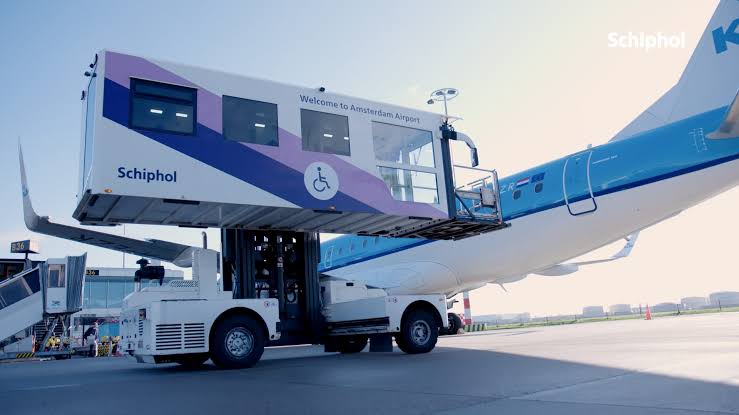
    Ensure you arrive at the airport at least two hours in advance. Always insist that your own wheelchair remains with you until the gate. If the airline refuses this (which may be due to the airport layout), the wheelchair will be immediately registered as checked baggage, and you will be escorted by staff to boarding in a loaner wheelchair provided by the airport. If the aircraft does not have a jet bridge, you will be brought on board via the aircraft stairs if you are able to walk, or otherwise with a stair climber or scissor lift, depending on the available facilities. Assistance is always provided in this case.

  • Dismantle all fragile and loose parts before checking in.

    Think about the battery and headrests, cushions, and footrests. There are no tools available at the airport to remove parts, so consider in advance how to do this.

  • Dismantle the joystick of the electric wheelchair

    This is one of the most vulnerable and expensive components of an electric wheelchair. Ensure that nothing can happen to it and that airport staff do not accidentally change the settings. Explain to the staff how to put the wheelchair in neutral so that you can push it. It is most convenient to stick a manual with the key points on the chair.

  • Take photos of the wheelchair before you get in.

    If necessary, you can use this method to prove that damage to the wheelchair occurred during the trip.

  • Label your wheelchair and removable parts with your name and contact details

    Clearly label your wheelchair and any removable parts with your name, telephone number and, if useful, your flight number. If an item becomes separated from your wheelchair during transport, it will be easier to identify who it belongs to.

  • Take fragile or valuable removable parts with you as hand luggage

    Cushions, removable control units and other fragile parts may be damaged or lost during transport. If possible, take these items with you into the cabin. Check the airline's hand luggage rules beforehand to make sure they are permitted.

  • Put your wheelchair into the correct transport mode if necessary

    Prepare your wheelchair for transport according to the manufacturer's instructions. Only fold or remove parts when this is safe and necessary. Make sure loose parts are secured and that airport staff know how to transport the wheelchair safely.

  • Explain how your electric wheelchair can be moved safely

    Electric wheelchairs can be heavy and complicated to move manually. Clearly explain how your wheelchair should be driven, pushed and secured. Make sure staff know which parts of the wheelchair must not be used for lifting or moving it.

  • Show staff where the brakes, freewheel mechanism and main power switch are located

    Show airport staff where the important controls are located. A simple instruction card with photographs and arrows can be very useful. Clearly indicate which parts may or may not be disconnected or removed.

  • Bring important information about the battery with you

    Keep information about the battery type, capacity and any relevant manufacturer's instructions with your travel documents. If there are questions about transporting the battery safely, you will have the necessary information readily available.

UPON ARRIVAL AT THE AIRPORT

A final check when the wheelchair is ready at the baggage claim.

Take the time to test the various mechanical mechanisms and check if the electrical parts, such as the backrest, footrests, and lift, are working properly. If you discover anything unusual, let us know before you leave the airport; a small beep might seem insignificant, but it could result in a completely ruined vacation. If you follow our tips, check everything thoroughly, and always ask for help when needed, everything is guaranteed to run smoothly!

DURING BOARDING

  • Explain what assistance you need when transferring to the aircraft seat

    Clearly explain to the assistance staff how they can best help you. Tell them what you can do independently and where you need support. If you require a specific transfer or lifting technique, discuss this before the transfer begins.

  • Check that your wheelchair has been taken for transport

    If possible, ask before departure whether your wheelchair has been handed over for loading onto the aircraft. Especially if you use an electric or customised wheelchair, it can provide peace of mind to know that it has been correctly accepted for transport and is travelling on your flight.

  • Ask where removable wheelchair parts will be stored

    Ask what will happen to any parts that have been removed from your wheelchair. Take fragile components into the cabin with you where possible. Make sure any parts travelling in the cargo hold are clearly labelled and properly protected.

  • Discuss what assistance you may need during the flight

    Cabin crew cannot provide every type of personal care or physical assistance. Discuss your needs before travelling and check what assistance the airline can provide during the flight. This is particularly important on longer flights.

  • Ask how using the toilet during the flight is arranged

    Toilet accessibility varies depending on the type of aircraft. Some flights have an onboard wheelchair that can be used to help you reach the toilet. Ask in advance what facilities are available and what assistance the cabin crew can provide.

  • Ask whether you can board the aircraft first

    Passengers who require assistance can often board before the other passengers. This can provide more time and space for a safe and comfortable transfer to the aircraft seat. Ask at the gate how boarding will be arranged for you.

Events calendar

IAHD is active not only online but also visible at diving trade shows.
Although we will not be present at every show, you can find a clear overview of the shows in 2027 here.
Our instructors provide IAHD training worldwide.
As soon as a course is registered with us, we add it to our events calendar so that you always stay up to date.

[arrow-down]
Date Diving Show / Expo City Country / Region
14–17 Jan Paris International Dive Show Paris France
23–31 Jan Boot Düsseldorf – Diving Düsseldorf Germany
5–7 Feb Duikvaker Houten Netherlands
19–21 Feb EUDI Show Bologna Italy
19–21 Feb DRT Show Malaysia Kuala Lumpur Malaysia
25–28 Feb Moscow Dive Show Moscow Russia
27–28 Feb GO Diving Show UK Coventry United Kingdom
12–14 Mar Mediterranean Diving Show Barcelona Spain
28–30 Mar ADEX China Shanghai China
9–11 Apr ADEX Singapore / Singapore Ocean Week Singapore Singapore
16–18 Apr DRT Show Taiwan Taipei Taiwan
23–25 Apr DRT Show Indonesia Jakarta Indonesia
24–25 Apr Scuba Show Atlantic City Atlantic City United States
14–16 May DRT Show Shanghai Shanghai China
15–16 May Scuba Show Anaheim Anaheim, California United States
21–24 May Thailand Dive Expo Bangkok Thailand
7–11 Jul ADEX Maldives Maldives Maldives
9–11 Jul DRT Show Beijing Beijing China
28–29 Aug NZ Boat, Fish & Dive Expo Hamilton New Zealand
24–26 Sep DRT Show Philippines Manila Philippines
2–5 Nov DEMA Show Orlando, Florida United States

Please note: This overview contains the 2027 dates that have already been announced. More international diving shows are expected to be added as organisers publish their 2027 schedules. Events in regions such as Australia, Japan, South Korea, Hong Kong, the Middle East, Africa and South America can therefore still be added later.

Downloads


Contact & Socials

IAHD Main Office
Wilhelminastraat 2
9611 JW Sappemeer
The Netherlands
Phone: +31 6 22 93 99 30